
Find a club that fits you
Run Club
This apps aim is to help users locate and join running clubs in their local area, facilitating both their interest in running and their desire to make new friends in a structured and approachable way.
Background
In conversations with fellow runners, I discovered a significant inconsistency in how people found their running clubs. Responses to the question, “How did you find this run club?” varied widely. Some runners relied on social media, others conducted extensive Google searches, and a few learned about clubs through word of mouth. Personally, I faced similar challenges when trying to locate the right running club. Although I eventually found one through social media, the process was anything but straightforward. The scattered and incomplete online information made the search time-consuming and frustrating.
Goal
The primary goal of my research was to understand the challenges and needs that runners face when searching for and joining local running clubs. By gathering insights from this research, I aimed to develop an inclusive and user-friendly app that simplifies this process and meets the needs of runners seeking a supportive community.
Research
What are my objectives?
Understand the factors influencing a runner’s decision to join or not join a club.
Investigate user preferences for event management, including scheduling, notifications, and RSVPs.
Identify pain points associated with attending and participating in running club events.
Identify the primary roadblocks runners encounter when searching for a club.
Determine the specific information users seek when evaluating potential clubs.
Explore the current methods used by runners to find clubs.
-
Strengths
Variety of fitness groups
Community Focused
In Person and Virtual events offered
Offers general events, not just fitness related events/groups
App reviews show that users like that it encourages you to explore your city
Groups can be found on a map for things near you specifically
Weaknesses
Not specifically for runners; lacks route mapping/performance tracking
Cost for organizers (barrier for smaller groups)
Anyone can start a group which can lead to quality control issues (ie. poorly managed or non-active groups)
App reviews state that some users find it the app difficult to navigate and difficult to avoid the amount of ads promoting their paid option
-
Strengths
Well known app among fitness community; large user pool
Tracks multiple types of workouts
tracks activityCan look for groups and clubs depending on spot and location
Can add/invite friends to join
Monthly challenges for users to participate int as well as customer challenges
Ability to sync to fitness tracker devices
Weaknesses
Emphasizes individual performance tracking and social aspect rather than locating Groups/Clubs
Many advanced features sit behind a subscription
Constant advertising of premium version through most aspects of the app
Slight learning curve for new users with all of the features
Cannot look at routes unless you pay for a subscription
-
Strengths
Strong brand association
Training Programs
Guided Runs (huge catalog with a wide variety)
Easy to navigate interface
Community and Custom challenges
Can track the mileage you put on your shoes
No pay barriers to the app, everything is free
Weaknesses
Focused on personal fitness and performance, not community based (in person)
Not many features
Social features are minimal
Many reviews in app store claim the app is glitchy
Disconnects from paired apps after each run (ie. spotify & apple music)
-
Strava's focus on individual performance and premium paywall for advanced features can subtract from the community aspects of run clubs. Its social features are secondary to its performance tracking, making it less specialized for users seeking community-focused running experiences.
Meetup is not specialized for fitness or running communities, which can make it difficult for runners to find tailored clubs and events. Its strengths lie in its wide reach, flexibility for event organization, and ease of use for both members and organizers.
Nike Run Club's strengths include a user-friendly interface, high-quality audio-guided runs, and the strong brand association with Nike. However, it does not emphasize running clubs or group events, making it less suitable for users seeking to join or manage a club. This app is for personal performance over social running.
Competitor Analysis
Methodologies
To gain a deeper understanding of what runners are looking for in a running group, as well as their motivations for joining one, I conducted a series of user interviews. These interviews aimed to uncover the specific needs and preferences that would inform the design of the RunClub app.
Interviews
7
Interviews
25-30
Age Range
18
Questions
Running Habits
Most users reported running 2-3 times per week, often varying between running for distance or time, depending on their training goals or how they felt on a given day. A strong preference for outdoor running emerged, with convenience being the primary factor influencing location choice.
Needs & Wants
Clear communication about pace groups, route details, and scheduled runs was highly desired. Participants expressed the need for a reliable communication channel for updates, with some currently using social media or messaging apps. There was interest in a feature that could indicate the recent activity level of a group, as some clubs have the potential to become inactive without users being aware.
Motivation/Interest
The social element of running clubs was a significant draw for many participants, with some valuing the community aspect and the motivation provided by the group without the pressure to compete. The change of pace offered by group runs was also appealing.
Finding Run Clubs
The majority of participants discovered running clubs through social media platforms like Instagram and TikTok, as well as through word of mouth.
Define
Personas
Based on the key findings insights gathered from the user interviews, I developed two personas to represent a runner and an organizer. These personas helped to guide design decisions by ensuring that the app would meet the needs and preferences of both types of users.

Jamie | 27 years old | Marketing Analyst | Kansas City, MO
Jamie is a Marketing Manager who has a passion for running. She started running regularly about 2 years ago and quickly fell in love with the sport. To combine her love for running with her desire to meet new people, Jamie started a local running club as a hobby. The club has grown over the last couple of months through social media but she’s looking for a dedicated platform to post all the details her runners need.
A dedicated platform to host and manage the running club, moving away from the limitations of social media.
Tools for managing member communication, event planning, and attendance tracking in one place.
Needs
Attract new members to the running club and retain existing ones.
Organize regular runs and social events that cater to diverse fitness levels and schedules.
Goals
Difficulty promoting the running club and reaching potential new members.
Managing logistics and coordinating events effectively, often feeling overwhelmed by the manual processes.
Pain Points
Alex | 29 years old | Account Manager | Washington, DC
Alex recently relocated to a new city for his job as an account manager. To maintain his fitness and manage stress, he runs 2-3 times a week. While he enjoys running, Alex finds it challenging to motivate himself for early morning runs or after a long workday. He is eager to join a running club to meet new people, stay motivated, and explore new running routes in his new environment.
A user-friendly app that helps him find local running clubs with compatible schedules.
A supportive community to keep him motivated
Features that include club size, average pace, running routes
Needs
Goals
Meet new people in his new city and build a social circle.
Stay motivated and consistent with his running routine.
Discover new and exciting running routes in the area.
Pain Points
Lack of knowledge of local route
Lack of a centralized resource for information on local running clubs.
Not familiar with city and active running groups

Problem Statements
Once we had personas to use as our target users, we identified two core challenges that affect both individual runners and local running clubs. The following problem statements outline these challenges and helped to guide me towards solutions that would create a more connected and efficient running community.
-
Many individuals interested in running lack a supportive community and structured environment to engage regularly in group runs, hindering their ability to stay motivated and achieve their fitness goals effectively.
How might we make it easier for users to discover local running clubs that fit their schedule, location, and pace preferences?
How might we help users with like-minded runners in their new city to stay motivated and build a sense of community? goes here
-
Existing local run clubs face challenges in reaching and engaging a diverse audience of runners due to limited visibility and accessibility, resulting in underutilized resources and missed opportunities to foster a broader running community.
How might we streamline the process for run club organizers to manage their run club so they can focus on the activities and community more?
How might we improve communication among club members to ensure everyone stays informed and engaged?
Ideate
User Flow
I chose to represent the user flow for creating a run club in my case study because it highlights one of the app's most critical features for club organizers. Focusing on this user flow allows me to showcase how the signup can be flexible by having the club creation occur during sign up as well as after.
Site Mapping
For the apps site map, I detailed the app's structure, focusing on intuitive navigation and a simplistic organization. The site map outlines the main sections—Home, Club Exploration and Profile. This structure was refined based on usability testing feedback to optimize user experience.
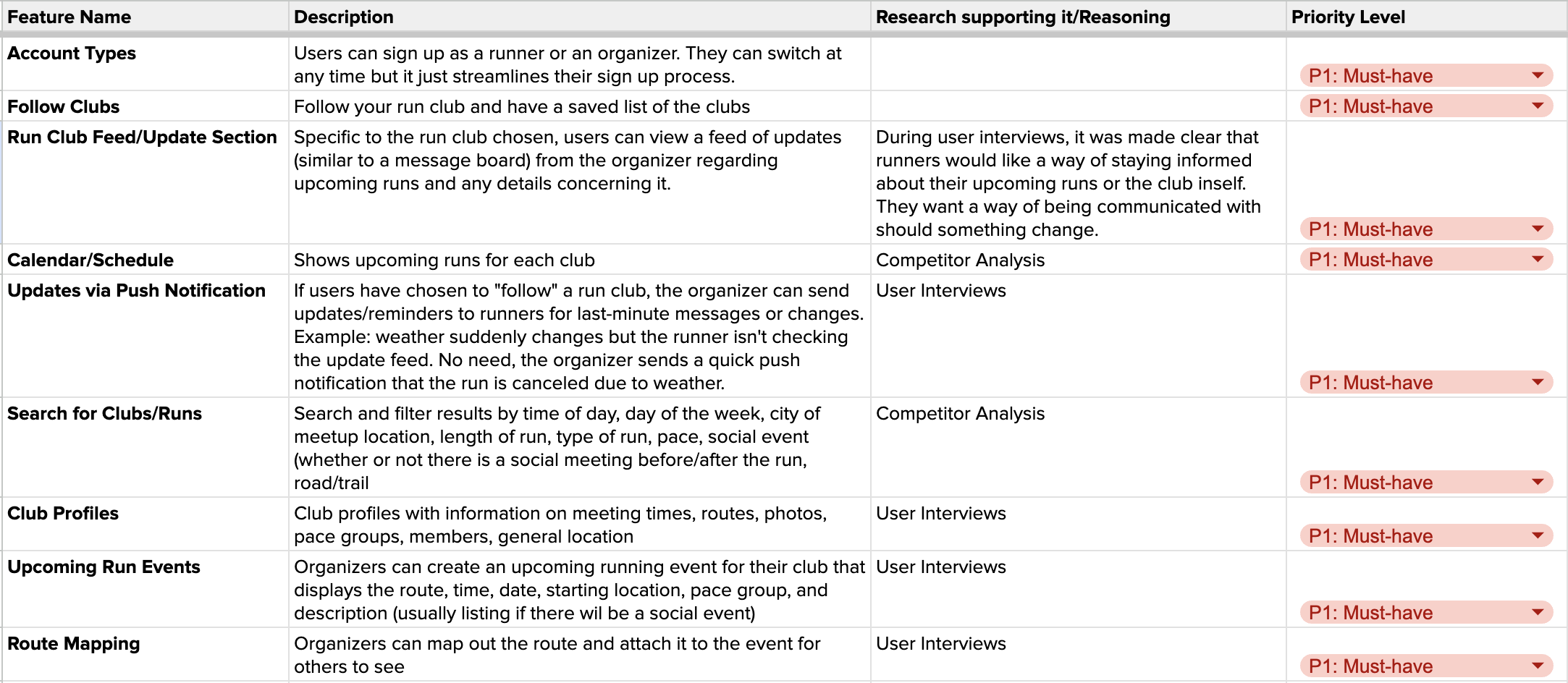
Feature Set: Priority 1
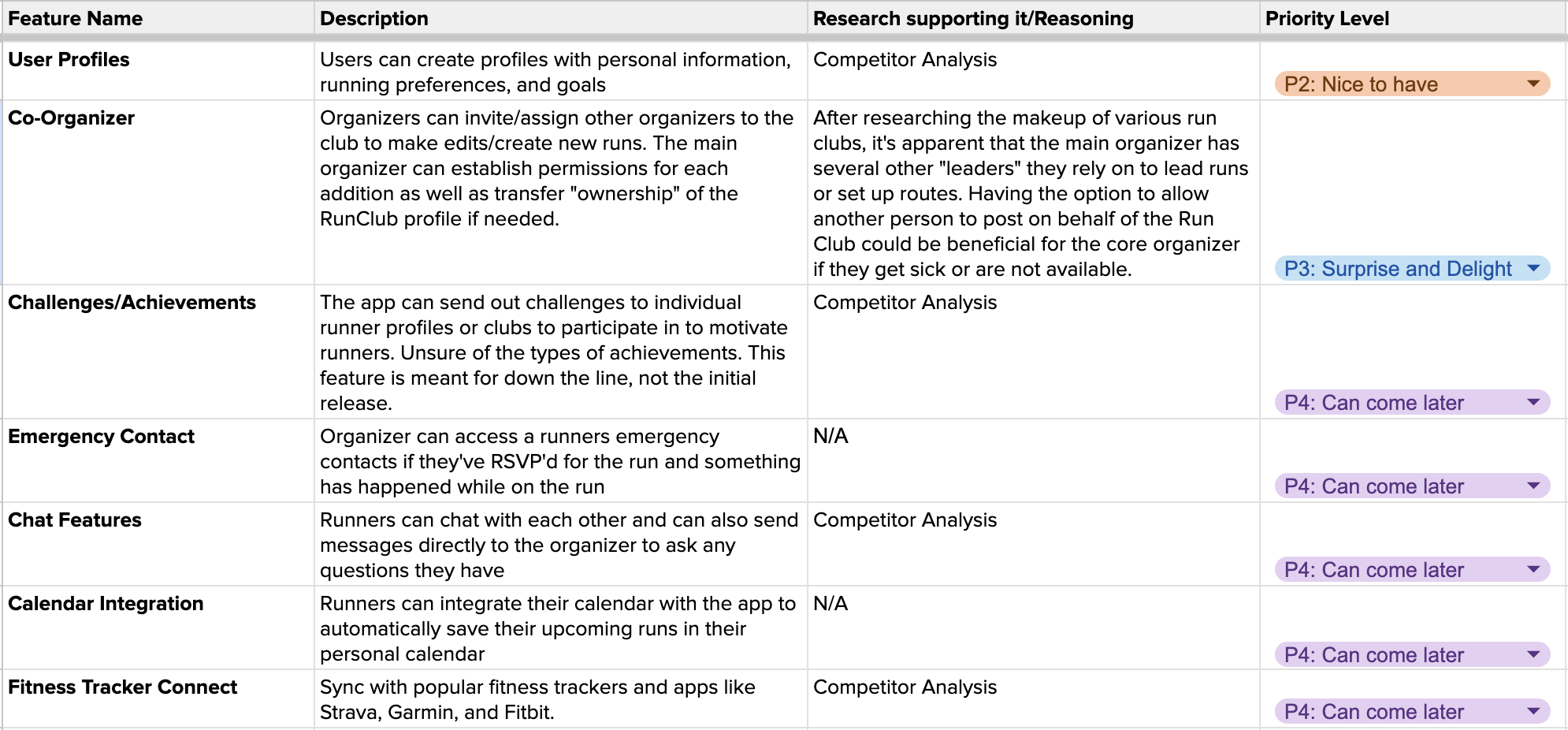
Feature Set: Priority 2-4
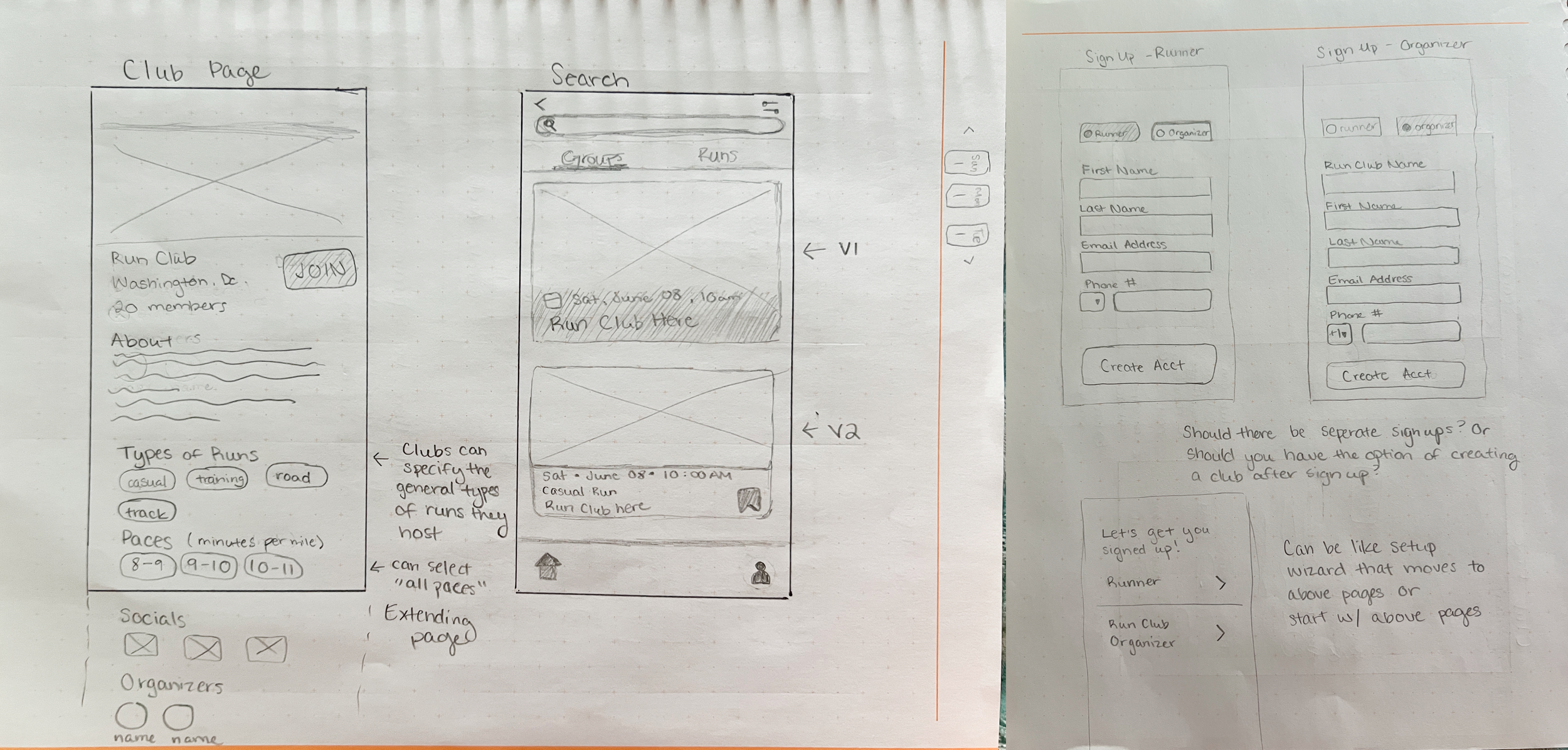
Low Fidelity Sketches
These sketches were used to explore the basic layout and structure of the app without focusing on detailed design elements. My goal was to quickly gather feedback prior to transferring the design to Figma.
Design
Mid Fidelity Wireframes
These wireframes were meant to build off of the feedback from the Low-Fi Sketches. Refining the sketches in a digital format to start painting the picture for users but not yet implementing the main color schemes or font styles. These frames were used for testing to establish a user friendly experience before reformatting for High Fidelity.
Color Palette
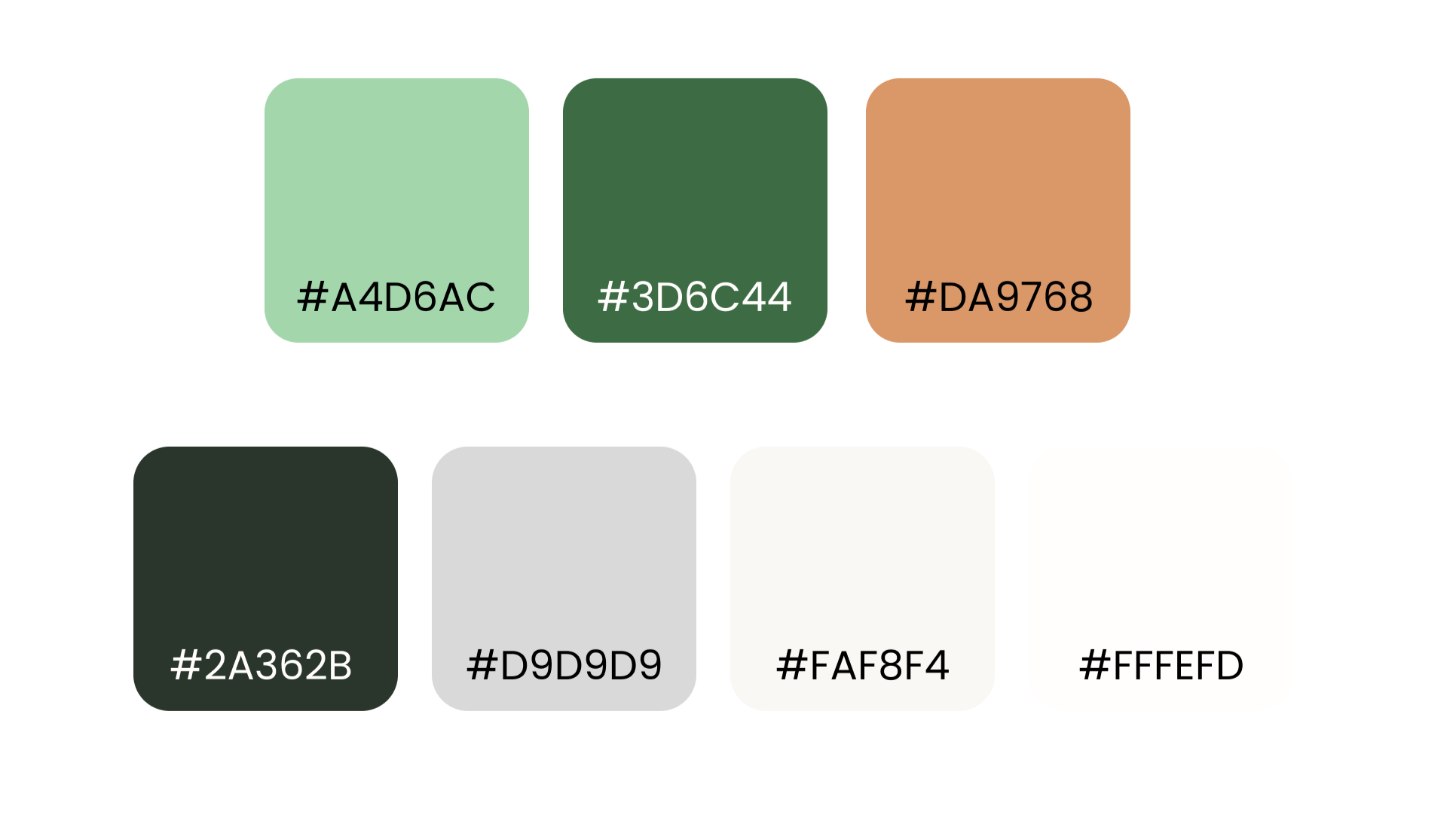
This color palette was picked for it's inviting tones and is meant to evoke a sense of balance and reliability in the user. The tertiary color is to add some enthusiasm to the screens, used sparingly and derived from one of the many colors of a track.

Font & Text Size
I chose the font style of Poppins for its range of weights and clean design. The sans-serif font style aids in it's readability while still being a fun and approachable font.
Logo
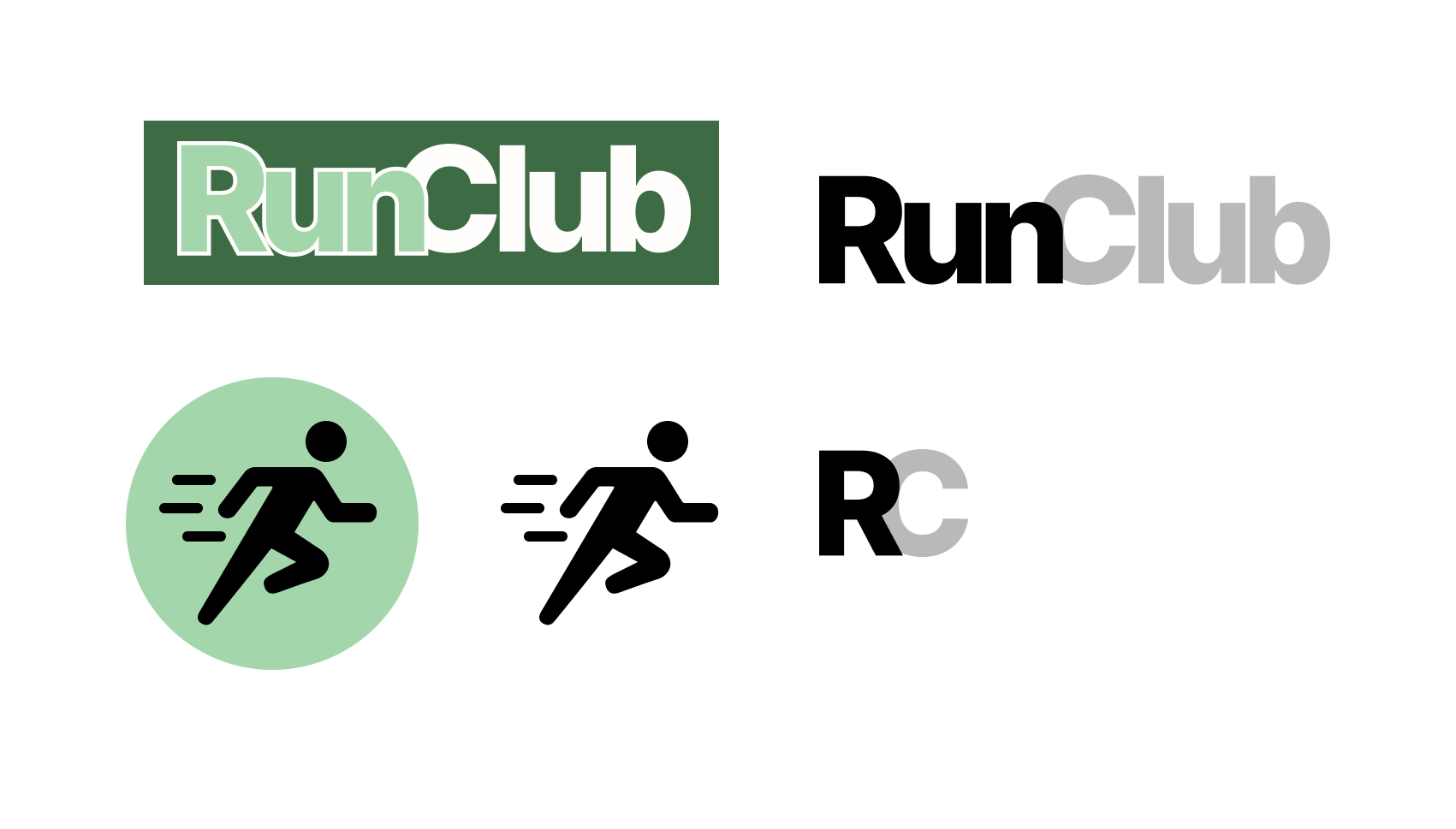
The logo for this app was easy to for me to design because what goes better with a run club app, than a runner? From personal experience with running, sometimes the more you complicate it, the less you want to do it. Making the logo easy to understand and approachable was my main goal.
Testing
Usability Testing
Testing the usability of the app wireframes to determine their effectiveness in providing a seamless user experience. This includes evaluating navigation, ease of finding information, and overall satisfaction with the design and functionality.
Participants
5 users were selected from the original interview pool to go through testing.
Tasks
Users completed 5 sets of tasks with each one being followed by 3 questions.
Tools
Figma Prototype & Maze
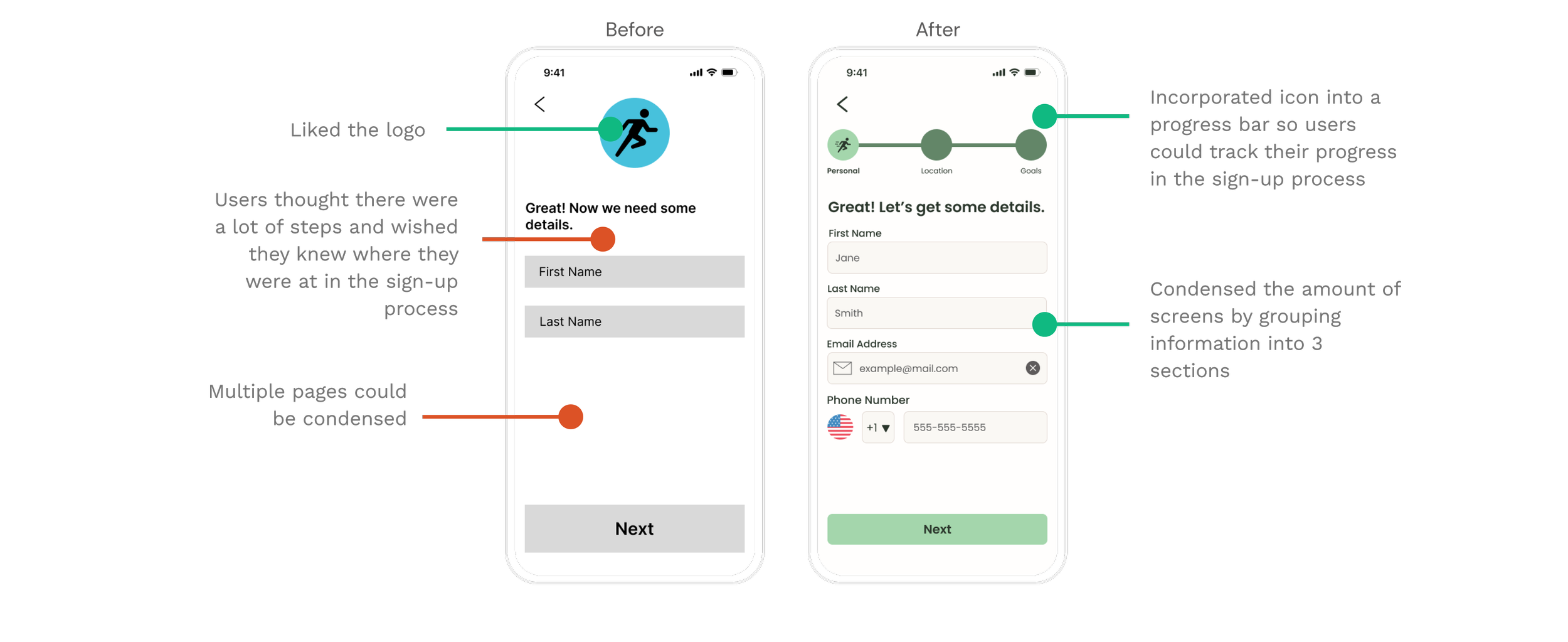
Sign Up Page
Run Event Page
Additional Insights
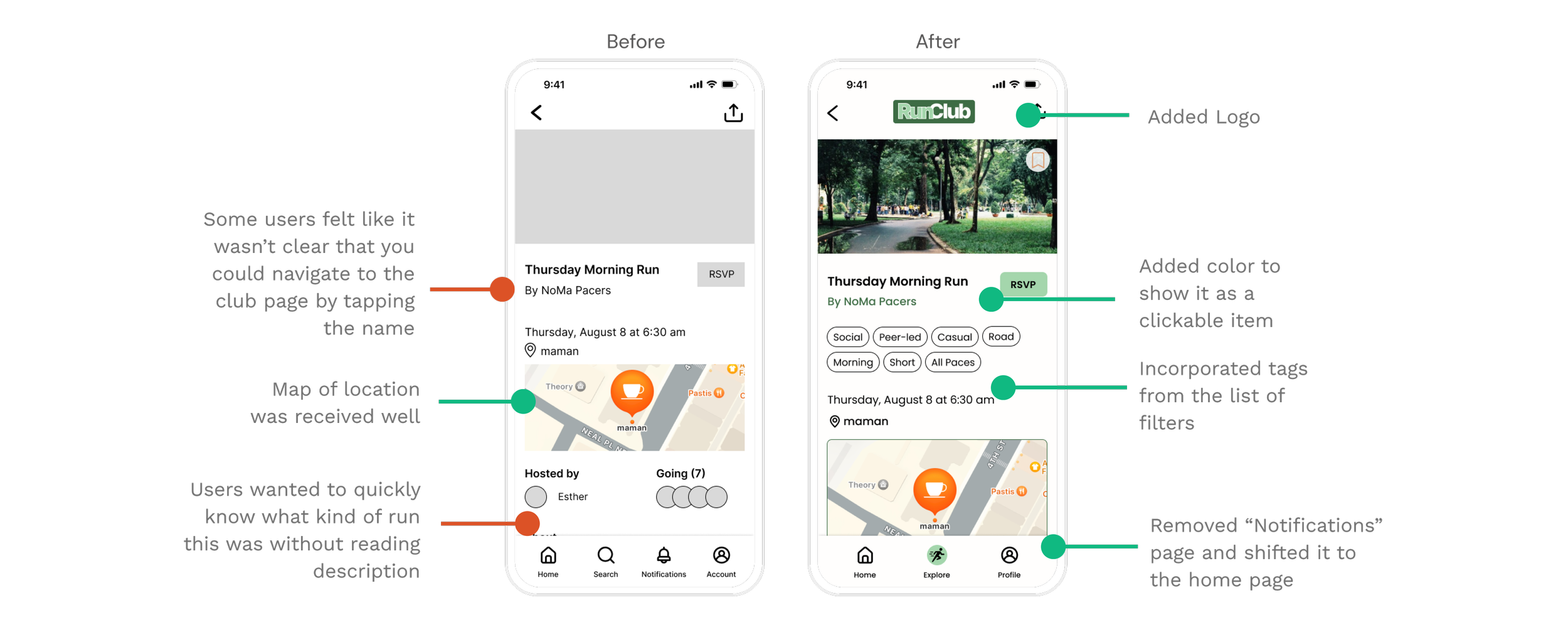
Other insights from user testing that influenced the first round of high-fidelity frames.
There should be a place to find saved runs
Photos would make the experience better
Account should be changed to Profile
Prototypes
Final Updates
After testing, additional prototypes were made and evaluated by my mentor. Several changes were made before finalizing the designs.
Explore Page
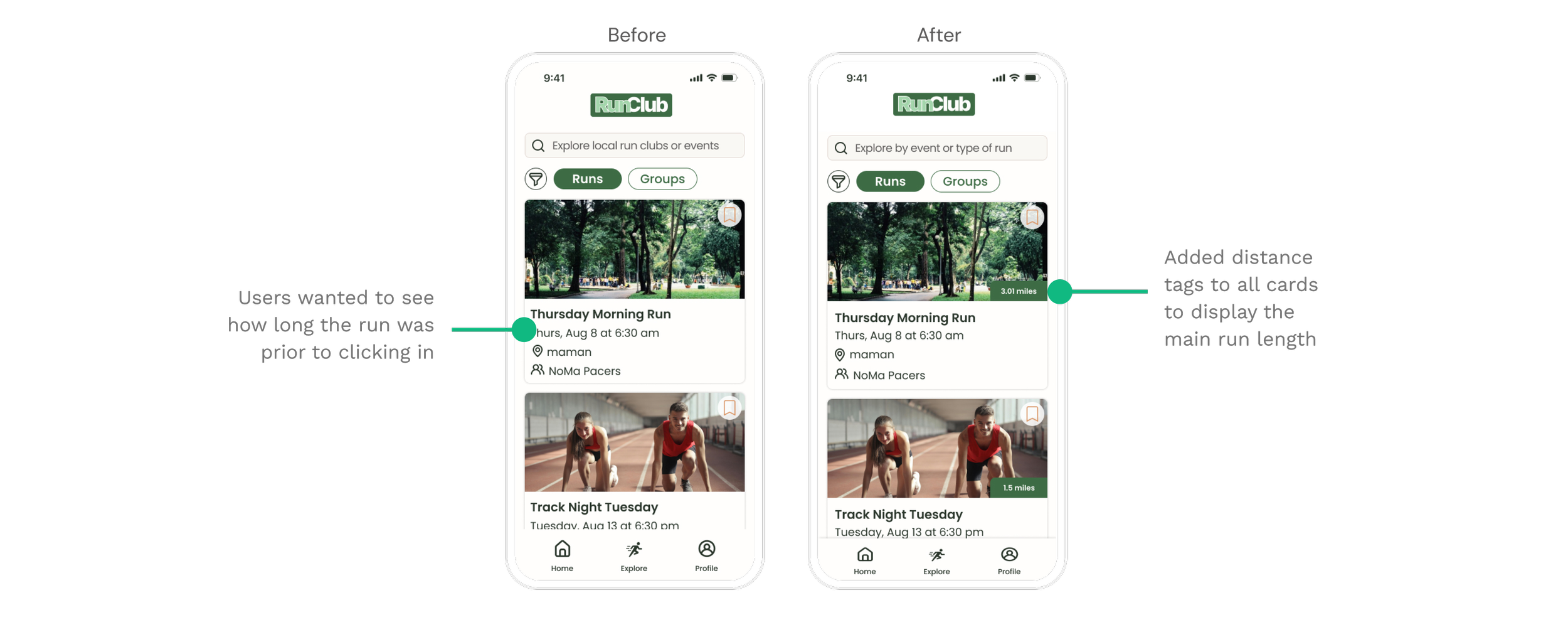
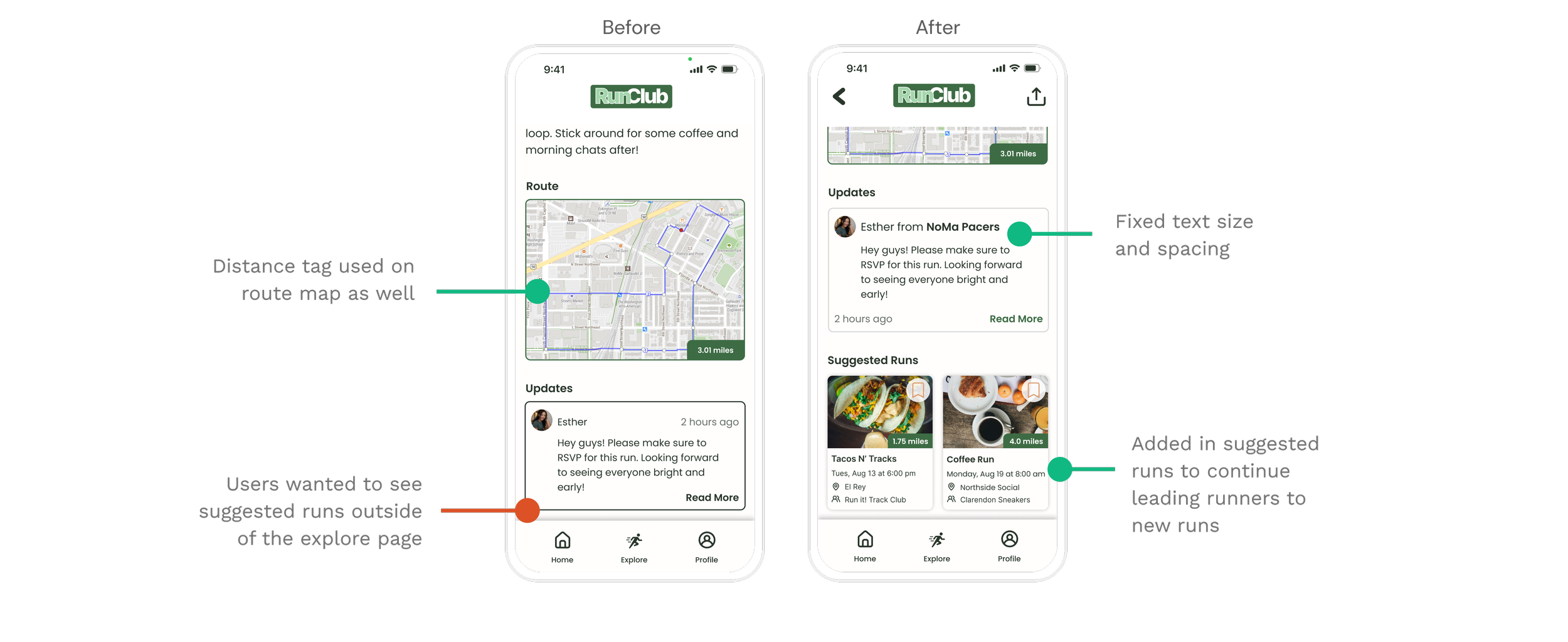
Run Event Page Update
Key Features
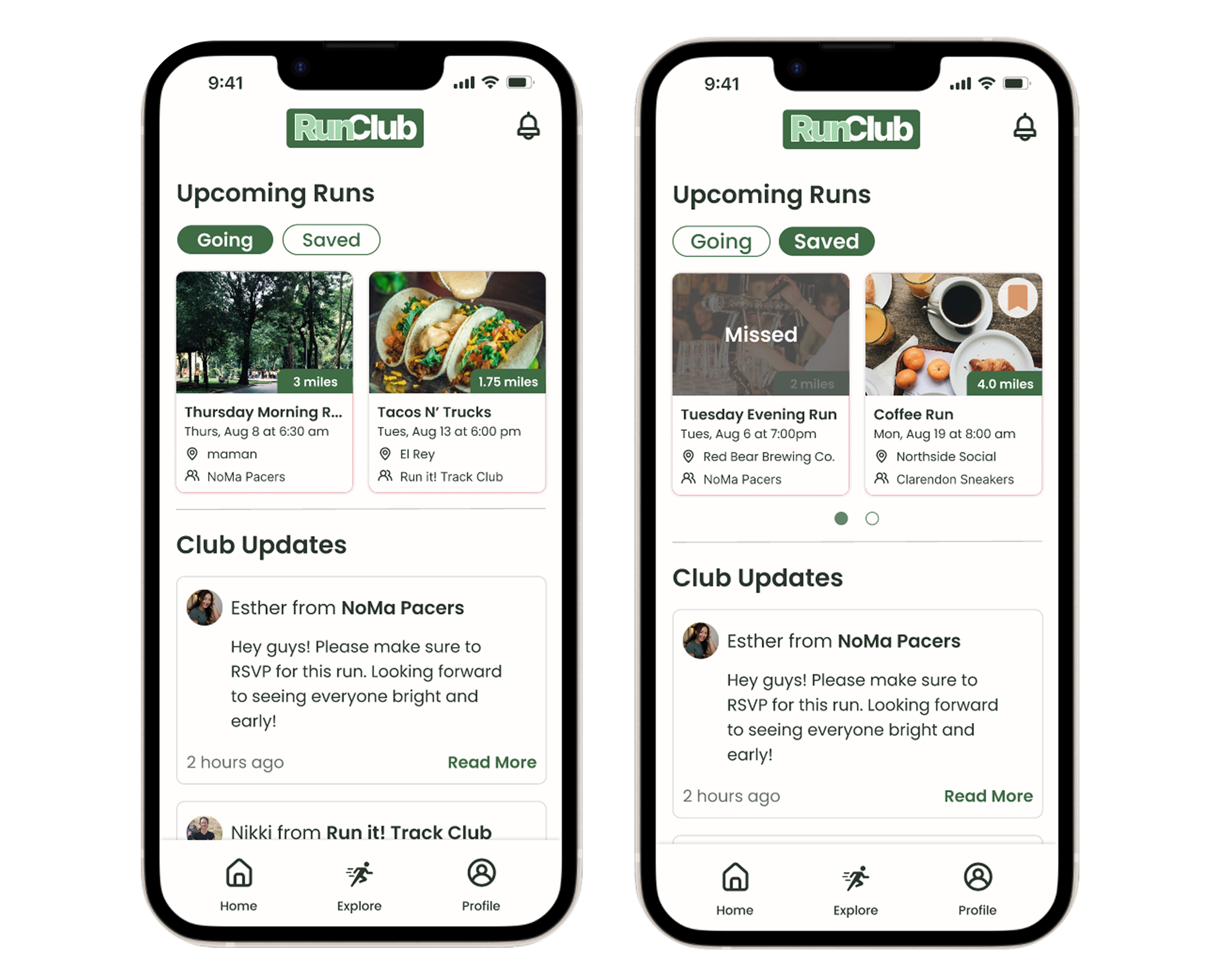
This is the dashboard, featuring your saved runs, RSVP'd events, and the latest updates from the users joined run clubs. It’s designed to keep users informed and organized, offering quick access to everything users need to stay engaged and motivated.
Home
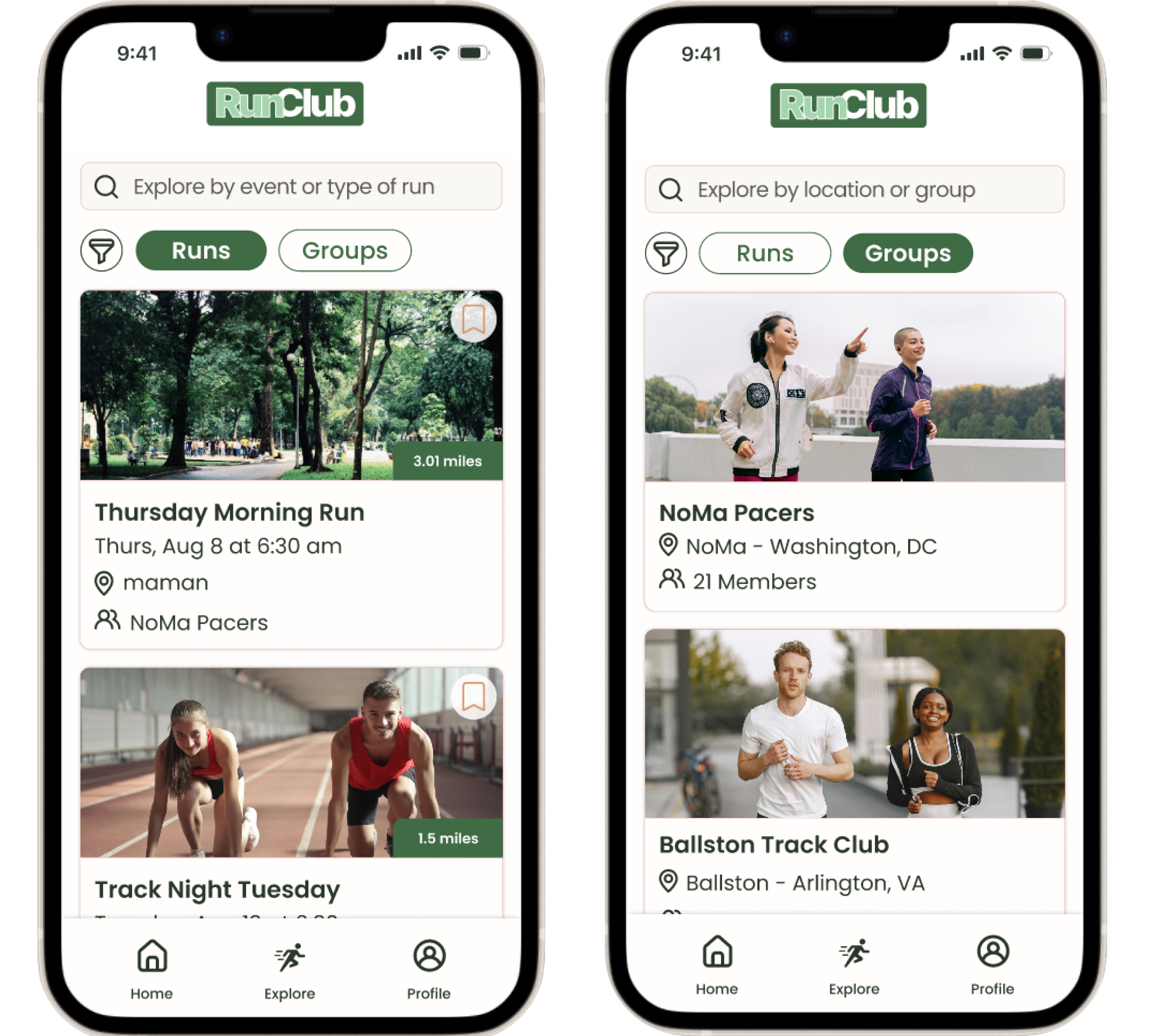
This feature allows you to discover local run clubs and upcoming running events tailored to your preferences. Users can filter their preferences to find the perfect running community or event that fits their schedule.
Explore
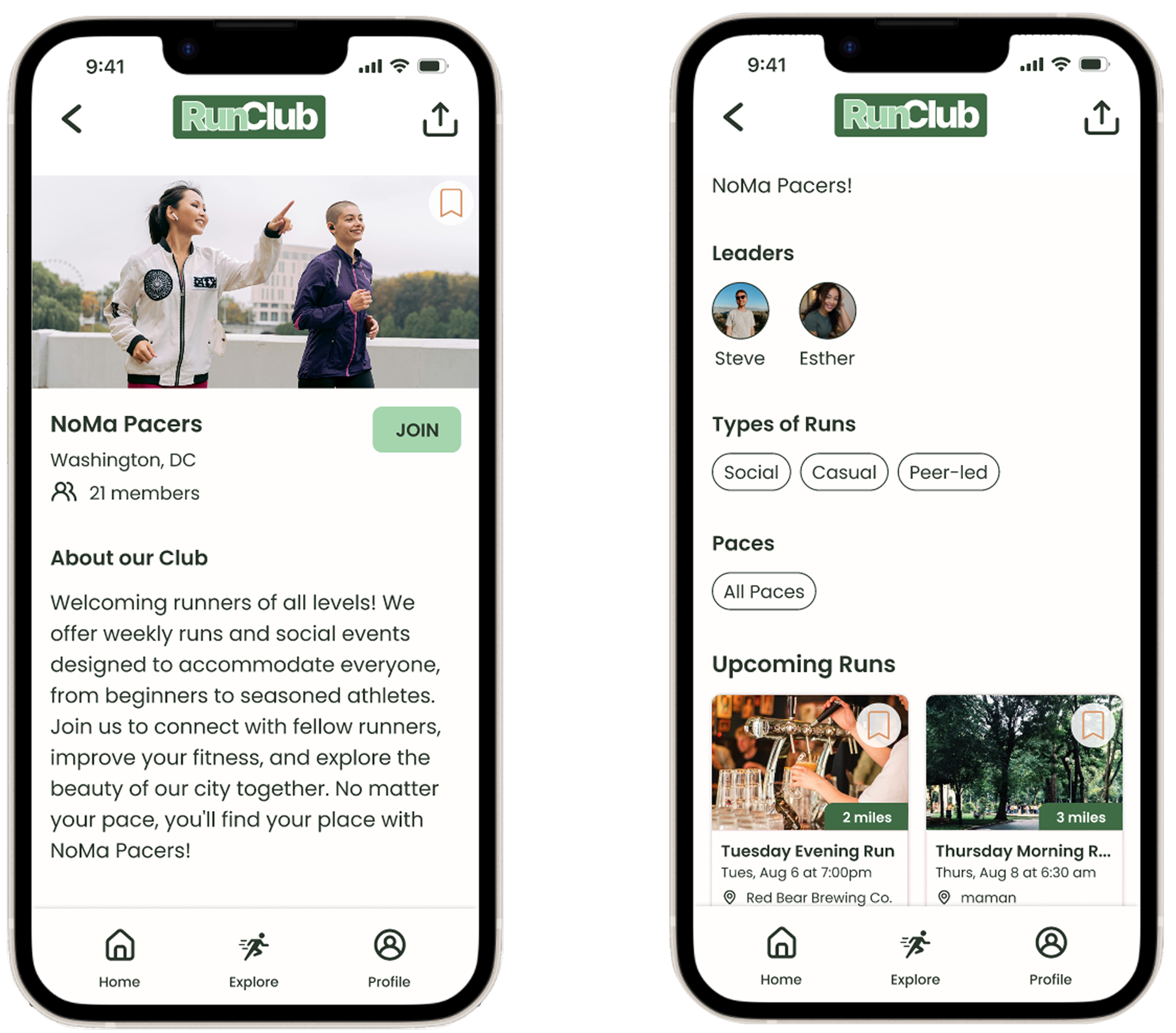
This is profile hub for Run Club groups, offering insights into its events, members, and upcoming events. Here, you can learn about the club's message and explore scheduled runs. It's the spot where you learn if this club is for you!
Run Club
Run Events
The Run Event page provides all the details you need for an upcoming run, including the route map, event description, and information about the hosts, and it's location. This page helps you prepare by listing the distance, pace, and any special instructions so users can hit the ground running fully prepared.
Final Prototypes
By opening the link, you can click through 3 different flows! Use the bottom arrows to move through the pages in each flow. Scroll through the frames if you’d like to see the full page that was designed.
My Conclusion
Working on the RunClub app was an incredibly informative and rewarding experience. Though this project was challenging, it provided me valuable experience that I plan to carry into my next project.
While the primary goal was to create a Minimum Viable Product (MVP), the insights gained throughout the interview process and testing rounds have led me to believe that this app has great potential for real world usage. With additional features and refinements, RunClub could evolve into a comprehensive platform that meets the needs of runners and club organizers.